
Green spaces, health and wellbeing along with growing your own.
We’re exploring the positive impact of allotments and the inspiring people who are using these spaces to improve sustainability and build community connections.
National Allotments Week is from 10th-16th August with the theme: ‘Grow to Learn – Lifelong lessons from the allotment’, which aims to highlight the educational, personal development, and wellbeing benefits of spending time on the plot.
Allotments are a valuable part of UK heritage, allowing those without gardens to learn how to grow their own fresh produce to supplement their weekly grocery shop. It also provides the opportunity to avoid chemically treated fruit and vegetables by choosing to garden organically. Not to mention the huge satisfaction gained from eating home-grown produce.
Yet far from just a place to grow food, allotments provide many more opportunities to plot-holders. Taking on a plot yourself, or helping out with a community plot, offers the chance to gain new knowledge and skills from a community of experienced gardeners. The educational benefit also extends to children and young people, who can learn valuable lessons about growing, seasonality, teamwork, patience and problem-solving.
It is widely acknowledged that spending time outdoors is beneficial to mental and physical wellbeing. Time in nature has been shown to reduce stress and improve mood, alleviating symptoms of anxiety and depression, and allotments offer the chance to connect with nature even in urban environments. In some instances, GPs even refer patients to community gardening activities to improve their wellbeing. Physical benefits come from the low-impact exercise that digging, weeding and planting provide.
While a traditional perception of allotments is as individual spaces, they are frequently spaces that serve as a link between individuals and the community for social interaction and mutual support. Many have evolved into community hubs that support different groups in society.
Caterham and District Horticultural Society has had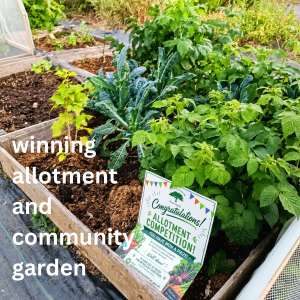 a community garden on the Westway allotments in Caterham-on-the-Hill for at least 10 years. Of the 120 Society members, a small number are regular volunteers on the plot and, while most are aged 40+, there are some younger people also getting involved.
“We did a gardening badge with the Brownies last year and we’ve had a conversation with the Guides and the Brownies about them having a patch,” says Karen Murray, the Society’s Treasurer, Membership Secretary and Event Organiser.
Once a month, the garden welcomes a group from Surrey Choices, a charity supporting disabled, autistic and neurodivergent people, for a walk, a cup of tea and to help with watering.
The Society holds a Horticultural Show twice a year, with the next one due in October, when the garden will be recognised with an award from the Parish Council Allotment Competition.
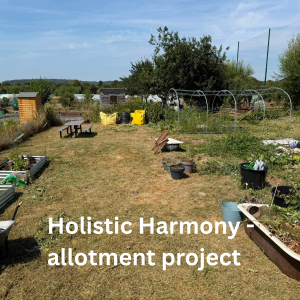
An allotment is the latest project for not-for-profit Community Interest Company, Holistic Harmony, set up by Shirley O’Donoghue. She is a lecturer in a wide range of holistic therapies and Principal of Lucis College in Dorking. In tandem with Waythrough, a charity offering mental health, drug and alcohol support, the company operates a Wellbeing Hub in Merstham offering complementary therapies to disadvantaged groups and individuals.
“When you do complementary therapies there’s a real interest in things like forest bathing and the beneficial aspects of nature, says Shirley, “so we want to combine that with the opportunity for people who want to learn how to do gardening to have access to doing that as well.”
She’s keen to open up the allotment to nature-lovers and would-be-gardeners alike. “I think gardening is quite meditative and when you’re seeing things grow it’s quite fulfilling, she says. “Then there’s the sensory side of it as well. That’s the healing effect and that’s where I think it links with what we’re doing at the Hub.”
 Louise Corrie, Community Project Lead at VASE, took on an allotment plot in May and has wasted no time in getting it up and running.
“At the moment I’ve got courgettes, spinach, beetroot, carrots, purple sprouting broccoli, cauliflower, red onions and rhubarb and I want to grow some fruit trees,” she says. “I’ve planted herbs as well, I’ve got lavender, rosemary, borage, and I’m going to add more. I think it makes such a difference when it’s fresh out of your garden.”
The sustainability aspect of growing her own food was a key driver for Louise and having a plentiful supply of fresh vegetables (pictured) means she no longer has to rely on supermarket produce. “I love the fact that I can go up there and pick a load of produce and there’s nothing on it, no pesticides, nothing,” she says. “It definitely provides you with enough. If you’ve got all your staples, you can reduce your food bill. It’s so worth it.”
For Louise, the allotment is also a place she can enjoy being in nature and soak up the benefits that brings. “I like seeing all the bees and butterflies,” she says. “I find it’s my happy place and I love going up there even just to water. It’s a little oasis.”
As part of National Allotments Week 2026, many allotments will be opening their gates to the public, so you can take the opportunity to visit your local allotment to gather gardening insight and tips from the plot-holders.
Find your local allotment space near you:
Allotments | Allotments, hiring pitches and pavilions | Parks, play and things to do | Tandridge District Council
Our allotments and how to get started | Allotments | Reigate and Banstead
The National Allotment Society website How to Find an Allotment | The National Allotment Society has information to help find an allotment near you and your local library may have details of local community gardening projects.
Written and researched by Diane Lane